The evidence behind our dark sky description
Dark-Sky Quality at Leonard’s Lookout
Leonard’s Lookout is located in Fuente Nueva, within the municipality of Orce and the Granada Geopark.
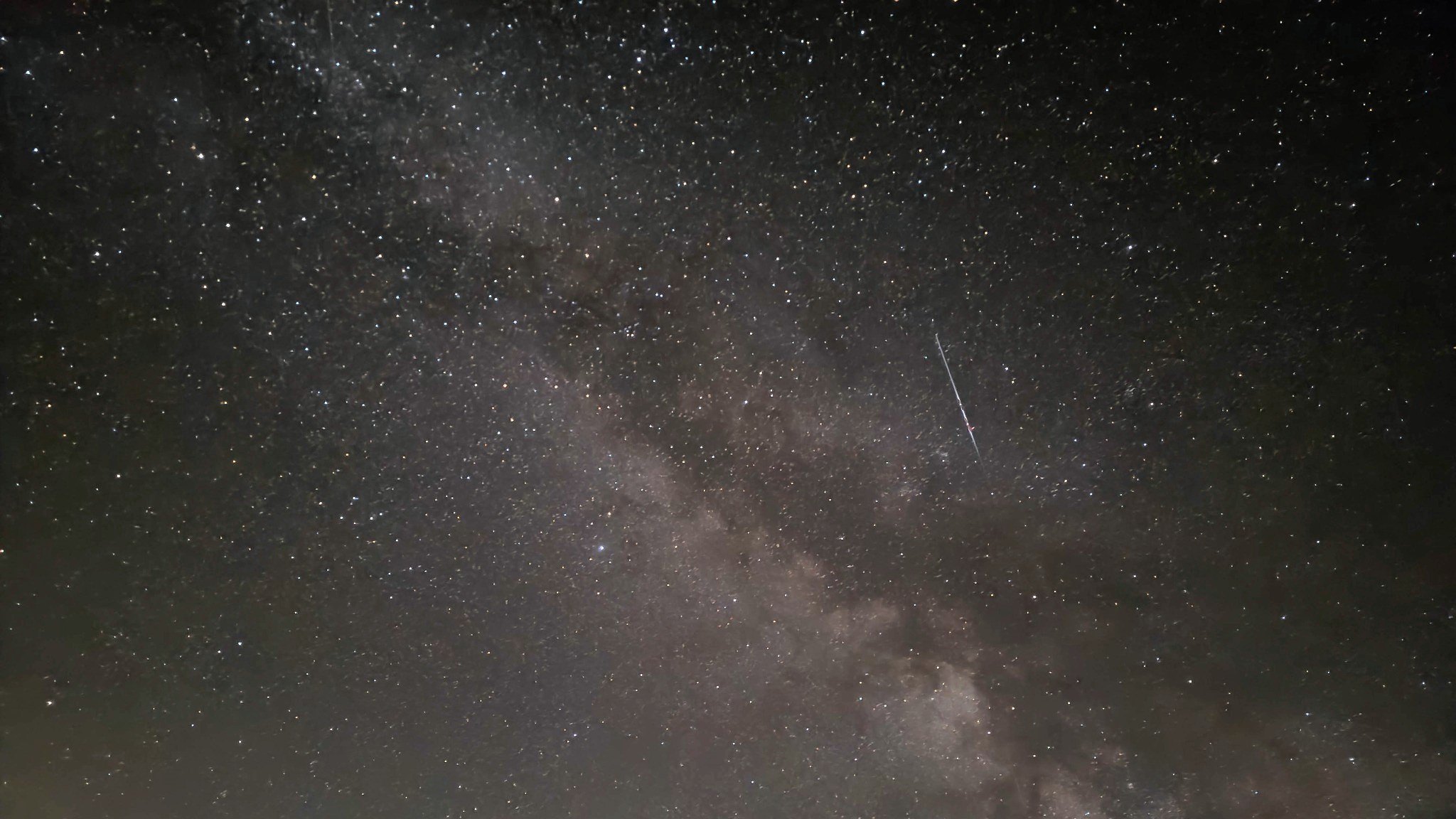
Official research by the Instituto de Astrofísica de Andalucía, IAA-CSIC, indicates exceptionally low levels of artificial sky brightness across this part of the Geopark. When our location is plotted against the study’s published maps, it falls within an estimated zenith sky-brightness band of approximately 21.7–21.8 mag/arcsec².
The available evidence is broadly consistent with Bortle 2–3 conditions. To avoid overstating what a regional model can prove at one individual property, we describe the skies at Leonard’s Lookout conservatively as Bortle 3.
The headline figures
Estimated zenith sky brightness
Approximately 21.7–21.8 mag/arcsec²
Technical interpretation
Broadly consistent with Bortle 2–3, depending on conditions
Public description
Bortle 3 skies
Research basis
IAA-CSIC Granada Geopark sky-quality study
Where the sky-brightness figure comes from
The Granada Geopark night-sky study was produced by the Office for Sky Quality at the Instituto de Astrofísica de Andalucía, IAA-CSIC, for the Diputación de Granada.
The research covered 4,722 km² across 47 municipalities. During 2021 and 2022, the team collected 107,861 ground-based sky-brightness records using mobile Sky Quality Meters, including instruments fitted with photometric filters to record colour information.
These measurements were combined with satellite observations and spatial modelling to create continuous maps of zenith sky brightness across the Geopark.
Plotting the Fuente Nueva area against the published V-band map places Leonard’s Lookout within the study’s darkest modelled category, at approximately 21.7–21.8 mag/arcsec². The highest calculated value reported across the entire study area was 21.77 mag/arcsec².
This is a modelled estimate for the area, supported by regional ground measurements. It is not a permanent meter reading taken at the property.
What does 21.7–21.8 mag/arcsec² mean?
Sky brightness is commonly expressed in magnitudes per square arcsecond. Unlike many measurement scales, a higher figure represents a darker sky.
A value around 21.7 mag/arcsec² indicates a very dark zenith with relatively little contribution from artificial light. For astrophotographers, darker sky backgrounds can improve contrast and make it easier to record faint structures in nebulae, galaxies, star fields and the Milky Way.
The figure describes background sky brightness. It does not, by itself, guarantee good seeing, transparency or weather on any particular night.
Why we describe the property as Bortle 3
The Bortle scale is an observational classification rather than a direct conversion from a sky-brightness measurement.
An observer assigns a Bortle class by considering several visible characteristics, including the structure of the Milky Way, zodiacal light, airglow, limiting magnitude and the presence of artificial light domes around the horizon.
Sky-brightness values around those modelled for Fuente Nueva can be associated with Bortle 2 conditions. However, the practical experience on any particular night can be affected by atmospheric transparency, humidity, dust, natural airglow, moonlight and light visible towards individual horizons.
For that reason, the evidence supports a realistic Bortle 2–3 interpretation, while Bortle 3 is the more conservative and defensible description for general use across the Leonard’s Lookout website.
On suitably clear, transparent and moonless nights, conditions may be closer to the darker end of that range.
What the research does—and does not—prove
The study provides strong independent evidence that Leonard’s Lookout lies within an exceptionally dark part of the Granada Geopark.
It does not provide:
1. An official Bortle number assigned to the property;
2. A permanent year-round reading from Leonard’s Lookout;
3. A guarantee of identical conditions every night;
4. A measure of cloud cover, seeing or transparency for future dates.
Moon phase, weather, atmospheric conditions and occasional local or distant lighting can all affect the sky visible on an individual night.
Guests planning an imaging stay should therefore consider the Moon, target position, astronomical darkness and seasonal weather alongside the underlying darkness of the location.
Within a Starlight-certified destination
Leonard’s Lookout lies within the Granada Geopark, which received international certification as a Starlight Tourist Destination in 2025.
The certification recognises the wider Geopark’s night-sky quality, efforts to limit light pollution and suitability for sustainable astrotourism. The IAA-CSIC sky-quality study formed part of the technical evidence supporting that process.
This is regional certification covering the Granada Geopark. Leonard’s Lookout has not been individually certified by the Fundación Starlight, and the certification does not assign the property a Bortle class.
Sources and further reading
IAA-CSIC: The night-sky quality of the Granada Geopark
The official explanation of the research, measurement programme and methodology.
Full scientific-technical report: Granada Geopark night-sky study
An overview of the study commissioned by the Diputación de Granada.
Fundación Starlight: Granada Geopark certification
Confirmation of the Geopark’s status as a Starlight Tourist Destination.
Planning an astrophotography stay?
Return to the main Astrophotography page for details of the outdoor setup areas, power, connectivity, accommodation and the types of imaging supported at Leonard’s Lookout.