Updated for July 2026
Deep sky objects in July range from the rich nebulae of Sagittarius and Serpens to the high summer fields of Cygnus. The rich nebulae of Sagittarius and Serpens are best photographed during the first part of the night, while Cygnus climbs high later and remains well positioned until dawn.
From Leonard’s Lookout at approximately 37.7° north, timing is particularly important for the low southern targets. The Lagoon, Trifid, Eagle and Omega nebulae are best tackled around midnight, before attention turns towards the planetary nebulae, emission regions and supernova remnants higher in the summer sky.
This guide includes bright, achievable targets for typical amateur equipment alongside more demanding projects for experienced imagers using longer focal lengths, mono cameras, narrowband filters and extended integration times.
Deep-sky objects in July at a glance
July nights are relatively short, but the summer Milky Way provides one of the year’s richest concentrations of nebulae, clusters and planetary nebulae. Around the middle of the month, full astronomical darkness at Leonard’s Lookout begins at approximately 23:25 and continues until shortly after 05:00.
The best moonless window is centred on the New Moon of 14 July 2026. If you are choosing dates around the darkest skies, our New Moon astrophotography stays in Spain guide explains how to plan a dedicated moonless imaging trip. Broadband targets, particularly objects containing reflection nebulosity, are best attempted close to this period. Emission nebulae can still be photographed farther from New Moon with suitable dual-band or narrowband filters.
The low Sagittarius and Serpens targets should be photographed as they approach their highest point in the south. Higher targets in Hercules, Lyra and Vulpecula provide greater flexibility later in the night. For photographers planning a dedicated imaging trip, Leonard’s Lookout offers astrophotography accommodation in Spain with Bortle 3 skies, outdoor setup areas and power access.
- New Moon: 14 July 2026
- Full Moon: 29 July 2026
- Full darkness near mid-month: approximately 23:25–05:05 CEST
- Best early-night target: M13, the Hercules Globular Cluster
- Best southern nebulae: M8, M20, M16 and M17
- Best later-night targets: M57 and M27
Best July targets for most amateur setups
These targets are bright enough to produce worthwhile results with widely used amateur cameras, mounts and telescopes. The suggested focal lengths are approximate rather than strict requirements, because the final framing also depends on sensor size.
M8 — The Lagoon Nebula
The Lagoon Nebula is one of July’s most rewarding imaging targets. This large, bright emission nebula in Sagittarius contains glowing hydrogen, dark dust structures and the open cluster NGC 6530.
From Leonard’s Lookout, M8 reaches a maximum altitude of approximately 28 degrees, so it should be photographed close to its highest point at around 00:45 in the middle of July. A clear southern horizon is important.
Suggested focal length: approximately 250–700mm
Suitable filters: broadband, dual-band or narrowband
Difficulty: easy to moderate
Main challenge: limited altitude and atmospheric disturbance near the southern horizon
M20 — The Trifid Nebula
Located close to the Lagoon Nebula, M20 combines emission nebulosity, blue reflection nebulosity and prominent dark dust lanes. It can be framed alone or photographed together with M8 using a wider-field system.
M20 reaches approximately 29 degrees above the southern horizon and culminates at roughly 00:45 in mid-July. Broadband imaging close to New Moon is particularly useful because a narrowband or dual-band filter will not reproduce its blue reflection component fully.
Suggested focal length: approximately 350–800mm
Suitable filters: broadband for natural colour; narrowband for the emission regions
Difficulty: moderate
Main challenge: preserving both the red emission and blue reflection nebulosity
M16 — The Eagle Nebula
The Eagle Nebula in Serpens is a strong target for medium focal lengths and narrowband imaging. Its central region contains the famous Pillars of Creation, although resolving fine detail within them requires suitable image scale, good seeing and careful processing.
M16 climbs to approximately 38 degrees at Leonard’s Lookout and reaches its highest point at around 01:00 in mid-July. This makes it more forgiving than the lower Sagittarius nebulae.
Suggested focal length: approximately 500–1,200mm
Suitable filters: broadband, dual-band or SHO narrowband
Difficulty: moderate
Main challenge: resolving structure without overprocessing the bright central region
M17 — The Omega Nebula
M17, also known as the Omega, Swan or Horseshoe Nebula, is a bright emission nebula in Sagittarius. Its strong hydrogen and oxygen emissions make it suitable for colour, dual-band and narrowband imaging.
It reaches approximately 36 degrees above the horizon and culminates shortly after 01:00 during mid-July. The bright central shape is relatively easy to record, while the surrounding faint nebulosity rewards longer integration.
Suggested focal length: approximately 400–1,000mm
Suitable filters: broadband, dual-band or SHO narrowband
Difficulty: easy to moderate
Main challenge: retaining detail in the bright core while revealing the fainter outer gas
M13 — The Great Hercules Cluster
M13 is one of the northern sky’s finest globular clusters and is already well positioned when astronomical darkness begins. From Leonard’s Lookout it passes almost directly overhead, reaching approximately 89 degrees in altitude.
Globular clusters do not benefit from narrowband filtration. Use broadband colour and avoid exposures long enough to saturate the densely packed central stars. Combining shorter and longer exposures can help preserve the core while recording fainter outer members.
Suggested focal length: approximately 500–1,500mm
Suitable filters: broadband or UV/IR cut
Difficulty: easy to moderate
Main challenge: preventing the bright core from becoming a featureless white area
M27 — The Dumbbell Nebula
The Dumbbell Nebula is a large and bright planetary nebula in Vulpecula. It becomes especially well placed during the second half of the night and reaches approximately 75 degrees above the horizon.
M27 responds well to both broadband and narrowband imaging. Hydrogen-alpha and oxygen-III data can reveal faint outer structures beyond the brighter central dumbbell shape.
Suggested focal length: approximately 600–1,500mm
Suitable filters: broadband, dual-band, hydrogen-alpha and oxygen-III
Difficulty: moderate
Main challenge: balancing the bright central nebula with its much fainter outer shell
M57 — The Ring Nebula
M57 is a bright but very small planetary nebula in Lyra. It rises high in the summer sky and reaches approximately 85 degrees above the horizon, making atmospheric conditions considerably better than for the low southern targets.
Although easy to detect, the Ring Nebula needs a relatively long focal length and small image scale to show meaningful internal structure. Shorter focal-length systems can still record it, but it will occupy only a small part of the frame.
Suggested focal length: approximately 1,000mm or longer
Suitable filters: broadband, dual-band or oxygen-III
Difficulty: moderate to advanced
Main challenge: its small apparent size
Wide-field and mosaic targets
Cygnus becomes increasingly prominent as the night progresses and provides some of July’s best opportunities for short-focal-length telescopes, camera lenses and mosaics. These regions contain extensive emission nebulosity, dark dust lanes and crowded Milky Way star fields, so framing is as important as the choice of target.
From Leonard’s Lookout, the principal Cygnus targets climb above 80 degrees and pass close to overhead during the second half of the night. This makes them less affected by atmospheric extinction and turbulence than the low southern nebulae.
NGC 7000 and IC 5070 — The North America and Pelican Nebulae
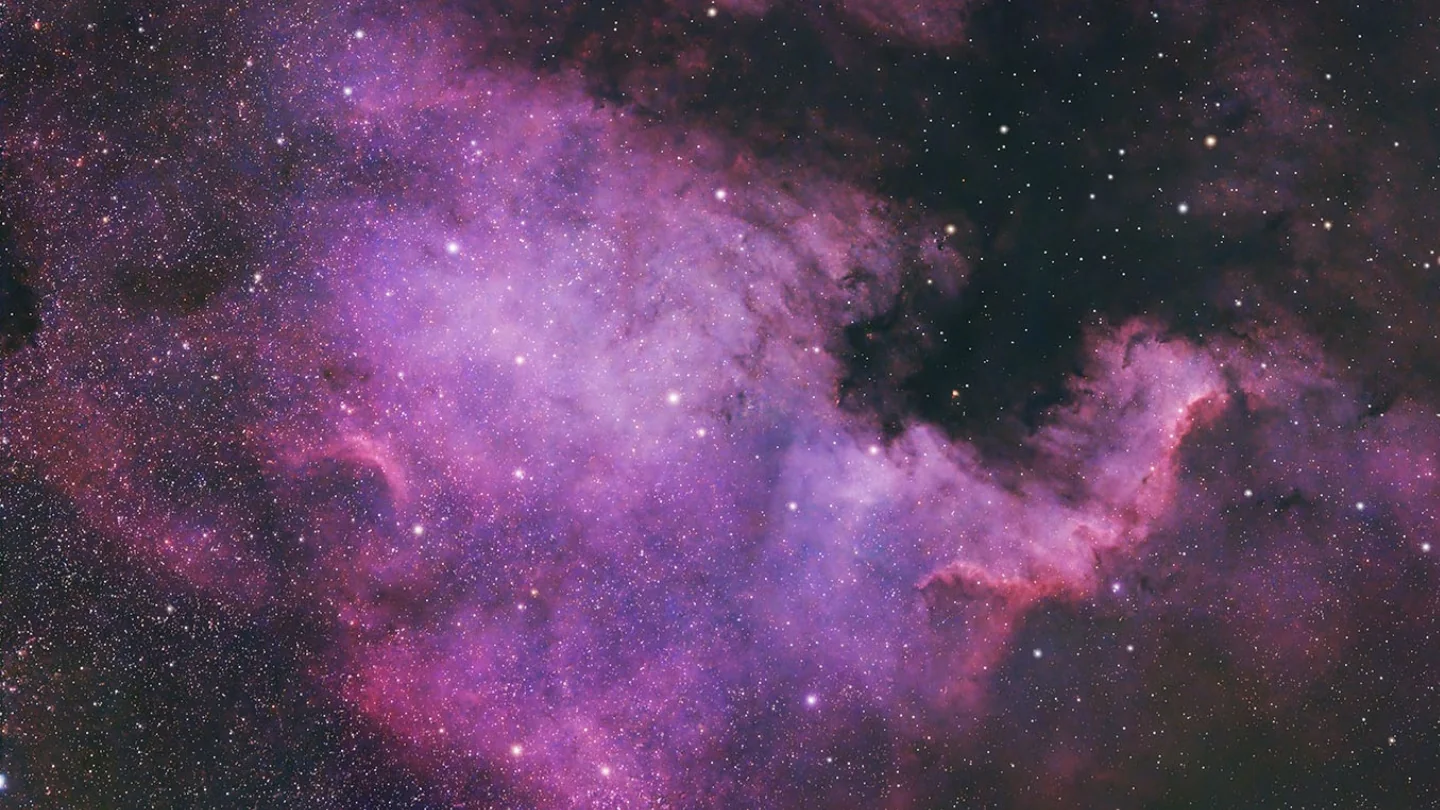
The North America Nebula and neighbouring Pelican Nebula form one of the finest wide-field imaging regions in Cygnus. Both are large emission nebulae separated visually by a dense lane of obscuring interstellar dust.
A short refractor or telephoto lens can frame both nebulae together, while a longer telescope can concentrate on structures such as the Cygnus Wall, the Pelican’s ionisation front and the surrounding dark clouds. The North America Nebula alone appears more than three times wider than the full Moon.
Broadband imaging is possible under dark skies, but hydrogen-alpha, dual-band and narrowband filters reveal considerably more of the extended emission. Broadband or RGB data can then be used to restore more natural star colour.
Suggested focal length: approximately 135–500mm
Suitable filters: broadband, dual-band, hydrogen-alpha or SHO narrowband
Difficulty: easy to moderate
Main challenge: fitting the complete region into the frame
Best time: approximately 01:30 until dawn
IC 1318 — The Sadr and Butterfly Nebula Region
The area surrounding Sadr, or Gamma Cygni, contains the extensive emission complex IC 1318, commonly called the Butterfly Nebula. Bright hydrogen clouds, dark dust lanes and dense star fields make it suitable for both wide-field imaging and detailed mosaics.
The dark nebula LDN 889 divides parts of IC 1318 and produces the prominent central rift through the glowing gas. The nearby field can also include the Crescent Nebula, open cluster NGC 6910 and other structures within the central Cygnus region, depending on focal length and orientation.
Sadr is extremely bright compared with the surrounding nebulosity. Processing therefore needs to control the star and any associated halo without suppressing the faint clouds around it.
Suggested focal length: approximately 200–600mm
Suitable filters: dual-band, hydrogen-alpha or SHO narrowband
Difficulty: moderate
Main challenge: controlling Sadr while retaining faint nebulosity
Best time: approximately 01:00 until dawn
The Veil Nebula and Cygnus Loop
The Veil Nebula is the visible portion of the Cygnus Loop, the expanding remains of a massive star that exploded thousands of years ago. Its delicate filaments extend across a very large area and emit strongly in hydrogen-alpha and oxygen-III.
A wide-field system can photograph the complete Cygnus Loop, while longer focal lengths can isolate the Western Veil around 52 Cygni, the Eastern Veil, Pickering’s Triangle or smaller filamentary structures. The entire complex covers an area approximately six times wider than the full Moon.
Dual-band filters work particularly well with colour cameras. Mono imagers can combine hydrogen-alpha and oxygen-III data, although the oxygen signal often requires careful exposure and processing to reveal the finer blue-green filaments.
Suggested focal length: approximately 250–600mm for the complete complex; 700–1,200mm for individual sections
Suitable filters: dual-band, hydrogen-alpha and oxygen-III
Difficulty: moderate
Main challenge: retaining faint filaments while controlling dense star fields
Best time: approximately 01:30 until dawn
One frame or a mosaic?
Before beginning a wide-field project, enter your telescope, camera and target into framing software such as Stellarium, Telescopius or an astronomy-planning application. Sensor size changes the field of view substantially, so focal length alone does not determine whether an object will fit.
A carefully planned two- or four-panel mosaic will usually produce a better result than cropping off important parts of a large nebula. Allow generous overlap between panels so that stacking and gradient correction remain manageable.
Advanced targets for high-end amateur equipment
The targets below demand more than simply pointing a longer telescope at a bright object. They reward accurate guiding, careful focus control, suitable image scale, strong calibration data and several hours of integration. Some are challenging because they are extremely faint; others are bright but so small that atmospheric seeing becomes the limiting factor.
These projects are best suited to experienced imagers using well-matched cameras and telescopes, although the Crescent Nebula itself remains accessible with more modest equipment.
NGC 6888 — The Crescent Nebula
NGC 6888 is a shell of gas surrounding the Wolf–Rayet star WR 136. Fast stellar winds from the central star are colliding with material expelled during an earlier stage of its evolution, creating the nebula’s complex arcs and filaments.
The bright crescent-shaped structure is achievable with many medium-focal-length systems. The more demanding project is to reveal the faint oxygen-rich envelope extending beyond the main shell. This requires substantial oxygen-III integration, dark skies and restrained processing.
From Leonard’s Lookout, the Crescent Nebula passes almost directly overhead during July and is particularly well placed during the second half of the night.
Suggested focal length: approximately 700–1,500mm
Suitable filters: hydrogen-alpha and oxygen-III, or SHO narrowband
Difficulty: moderate for the main shell; advanced for the outer oxygen envelope
Main challenge: recording faint oxygen-III signal without overwhelming it with stars
Best time: approximately 01:00 until dawn
Abell 39 — A Faint Planetary Nebula in Hercules
Abell 39 is an unusually symmetrical planetary nebula with very low surface brightness. Its nearly spherical shell makes it visually simple, but recording that shell cleanly against the background sky is a demanding imaging project.
The nebula emits strongly in doubly ionised oxygen, making oxygen-III the most useful narrowband filter. Long total integration, accurate flat-field calibration and careful gradient removal are more important than exceptionally long individual exposures.
Abell 39 is already high when full darkness begins in July. It should therefore be prioritised early, before it moves towards the west later in the night.
Suggested focal length: approximately 1,000–2,000mm
Suitable filters: oxygen-III, supplemented with broadband colour if required
Difficulty: advanced
Main challenge: extremely low surface brightness
Best time: astronomical darkness until approximately 02:00
NGC 6543 — The Cat’s Eye Nebula
The Cat’s Eye Nebula is a compact planetary nebula in Draco with concentric shells, knots and other intricate structures formed during the late evolution of its central star. Hubble observations show that the object contains considerably more detail than its bright central appearance initially suggests.
The central nebula is bright, but extremely small. Capturing internal structure requires long focal length, precise collimation, excellent focus and stable seeing. Short exposures can help prevent the bright core from saturating, while much longer integration is required to reveal the extensive faint outer halo.
The Cat’s Eye remains high throughout July nights from Leonard’s Lookout and can be used when lower southern targets are affected by atmospheric turbulence.
Suggested focal length: approximately 1,500–3,000mm or longer
Suitable filters: broadband, oxygen-III and hydrogen-alpha
Difficulty: advanced
Main challenge: resolving fine structure while preserving the bright central core
Best time: throughout astronomical darkness
NGC 7027 — A Compact Planetary Nebula in Cygnus
NGC 7027 is a young planetary nebula in Cygnus with bright, complex shells of gas surrounding its obscured central star. It is an excellent high-resolution target, but its small apparent size makes it poorly suited to short-focal-length systems.
This is a target for long focal lengths, small pixels and nights of steady seeing. Because the central region is bright, relatively short sub-exposures may produce better results than the long exposures normally associated with faint nebulae. Imaging on several nights and retaining only the sharpest frames can improve final resolution.
NGC 7027 becomes increasingly well placed after midnight and climbs very high before dawn.
Suggested focal length: approximately 1,500–3,000mm or longer
Suitable filters: broadband, hydrogen-alpha and oxygen-III
Difficulty: advanced
Main challenge: extremely small apparent size and seeing-limited resolution
Best time: approximately 02:00 until dawn
What counts as high-end amateur equipment?
High-end amateur imaging does not necessarily mean using the largest available telescope. A well-matched system with accurate tracking, reliable autofocus, appropriate sampling and high-quality calibration will usually outperform a larger but poorly controlled setup.
For small planetary nebulae, angular resolution and seeing matter more than total field of view. For faint shells such as Abell 39 or the outer envelope of NGC 6888, total integration time and clean oxygen-III data become the greater priorities.
A practical July imaging plan
July offers fewer hours of full darkness than autumn or winter, so efficient planning matters. The target list above should not be treated as an invitation to photograph several objects briefly during the same night. In most cases, one long, uninterrupted imaging run will produce a better result than repeatedly changing targets.
The schedules below are rounded planning windows for the middle of July at Leonard’s Lookout. Exact timing changes throughout the month, so each session should be checked in Stellarium or equivalent planning software using the actual date, equipment and horizon. The principal moonless period is centred on the New Moon of 14 July 2026.
Before astronomical darkness
Use the remaining twilight to complete the tasks that do not require a fully dark sky. The mount should already be level, balanced and polar aligned before the main imaging window begins.
A sensible preparation sequence includes:
- cooling the camera to its operating temperature;
- checking cables and power connections;
- completing polar alignment;
- confirming plate solving and guiding;
- calibrating the guider if required;
- setting an initial focus position;
- preparing the sequence and meridian-flip settings;
- taking dusk flats where appropriate.
Start the first test exposures early enough to identify tilt, guiding, framing or focus problems before full darkness arrives.
Plan A — Low southern nebulae
The Lagoon, Trifid, Eagle and Omega nebulae should be prioritised during the first part of the night because they remain relatively low from southern Spain and begin moving west after culmination.
A practical mid-July sequence is:
- Approximately 23:25–00:15: frame, focus and begin imaging while the target approaches its highest point;
- Approximately 00:15–01:15: strongest imaging window for M8, M20, M16 and M17;
- Approximately 01:15–02:15: continue while the target remains acceptably placed, depending on the local horizon and atmospheric conditions;
- After approximately 02:15: either continue if the data remain clean or move to a higher secondary target.
Do not switch repeatedly between M8, M20, M16 and M17. Choose one main composition for the night. A wide-field system may frame M8 and M20 together, but longer-focal-length systems should normally concentrate on one object.
Plan B — A full night in Cygnus
Cygnus provides the simplest option for gathering uninterrupted integration. The Crescent Nebula is already well placed when full darkness begins, while the Sadr region, Veil Nebula and North America Nebula continue climbing during the night.
A Cygnus target can therefore be photographed from approximately 23:30 until dawn without changing objects. This is often preferable to spending the early hours on an unrelated target and losing time to reframing, refocusing and recalibrating the guider.
For a complete North America and Pelican composition, the Veil complex or a Sadr-region mosaic, check the camera orientation and panel layout before darkness. A framing mistake discovered after several hours is difficult to correct during a short summer night.
The Crescent, North America and Veil nebulae are distinct objects within the same rich Cygnus region, and each can support a complete multi-hour project.
Plan C — Globular clusters and planetary nebulae
Long-focal-length systems can use the early part of the night for M13, Abell 39 or the Cat’s Eye Nebula. M57 becomes especially well placed around the middle of the night, followed by M27 and NGC 7027 later.
A sensible sequence might be:
- Approximately 23:25–01:15: M13, Abell 39 or the Cat’s Eye Nebula;
- Approximately 01:15–02:30: M57 or continued imaging of the original target;
- Approximately 02:30–05:00: M27, NGC 7027 or another high Cygnus target.
Changing target once can be justified when the first object becomes poorly placed. Changing every hour usually produces several incomplete datasets rather than one strong image.
M13 is a globular cluster, whereas M57 and M27 are planetary nebulae. Their exposure lengths, filtration and processing requirements should therefore be planned separately.
One target or two?
For most July sessions, use one primary target and identify one secondary target only as a contingency. The secondary target should require minimal equipment changes and should become better placed as the primary target moves west.
Suitable combinations include:
- M8 or M20 followed by M27
- M16 or M17 followed by the Crescent Nebula
- M13 followed by M57
- Abell 39 followed by NGC 7027
A full-night Cygnus project generally needs no secondary target. Continuous integration on the North America and Pelican region, the Veil, Sadr or the Crescent will usually be more valuable.
Photographing deep-sky objects from Leonard’s Lookout
Leonard’s Lookout provides a private base for astrophotographers in rural southern Spain at approximately 37.7° north. The location offers access to the low summer targets of Sagittarius and Serpens, while Cygnus, Lyra, Hercules and Vulpecula climb much higher during the night. For more detail on the local sky conditions, the sky quality page explains the dark-sky modelling and why the site is described as Bortle 3.
Guests bring their own cameras, mounts, telescopes and imaging equipment, then work directly from the property. Power is available at both the front and back, allowing different setup positions to be used depending on the target, horizon and equipment.
The practical facilities include:
- power available at the front and back of the property;
- Starlink Wi-Fi throughout the house and outside;
- outdoor setup areas with open views;
- a fully equipped office for planning, image processing and remote work;
- private accommodation for multi-night imaging projects.
The property is particularly suited to astrophotographers who want to leave equipment assembled across several nights rather than repeatedly transporting and rebuilding a complete setup.
These deep sky objects in July are well suited to multi-night imaging sessions from rural southern Spain, especially when planned around the New Moon window. These deep sky objects in July can be planned around several consecutive nights, allowing guests to build meaningful integration rather than relying on a single session. If your trip falls later in the season, see the August deep-sky objects guide for targets that become better placed after July.
You can find more information about the location, facilities and imaging conditions on our astrophotography accommodation in Spain page.