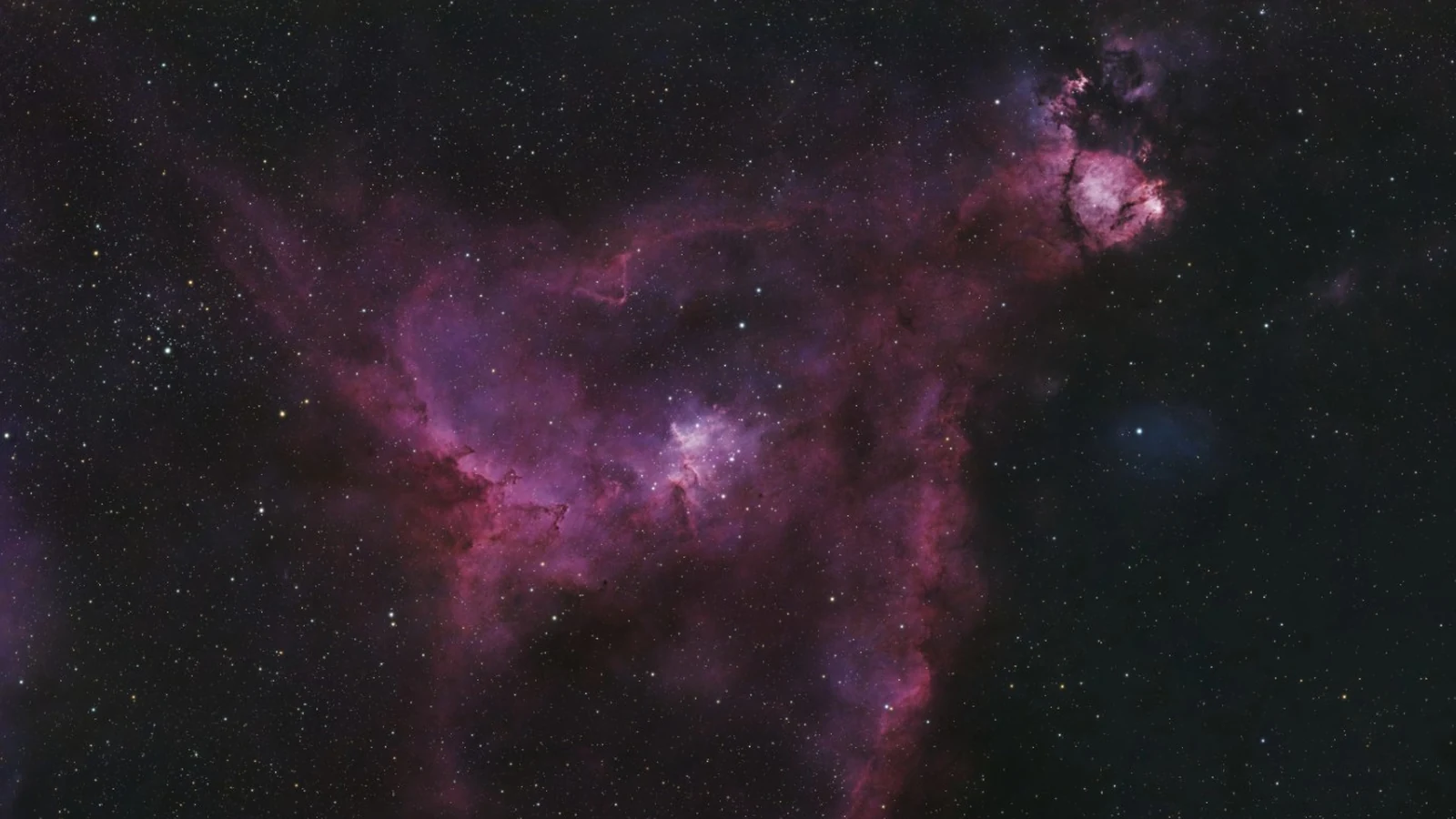
The Heart Nebula, photographed from Leonard’s Lookout.
Updated for August 2026
Deep-sky objects in August range from the remaining southern summer nebulae to the high Cygnus fields and the returning galaxies of autumn. The bright nebulae of Sagittarius and Serpens remain available during the first part of the night, while Cygnus stays high for extended imaging runs and the autumn galaxies begin rising into stronger positions later.
From Leonard’s Lookout at approximately 37.7° north, the low southern targets need to be prioritised before they move west. Higher objects in Cygnus, Lyra and Vulpecula offer much longer imaging windows, followed later by Andromeda, Triangulum, Cassiopeia and Perseus.
This guide includes achievable targets for commonly used amateur setups, large wide-field projects and more demanding objects for experienced imagers. It also provides a practical way to plan the night without repeatedly switching between unrelated targets.
Deep-sky objects in August at a glance
August provides longer periods of astronomical darkness than July, but the low southern summer nebulae are already moving west by the time the sky becomes fully dark. Cygnus remains dominant for most of the night, while Andromeda, Triangulum, Cassiopeia and Perseus become increasingly useful later.
The darkest period of the month is centred on the New Moon of 12 August 2026. Broadband galaxies, reflection nebulosity and natural-colour star fields are best planned close to this date. Emission nebulae offer more flexibility when suitable dual-band or narrowband filters are used. For longer trip planning, our New Moon astrophotography stays in Spain guide explains how to choose dates around the darkest skies.
By the middle of August, the Lagoon, Trifid, Eagle and Omega nebulae are already close to or beyond their highest point when full darkness begins. Equipment should therefore be aligned, focused and framed during twilight so that imaging can begin immediately.
August priorities include:
- New Moon: 12 August 2026;
- Full Moon: 28 August 2026;
- Best early-night targets: M8, M20, M16 and M17;
- Best full-night region: Cygnus;
- Best later-night galaxies: M31 and M33;
- Best later-night cluster: the Double Cluster in Perseus.
The most efficient plan is usually one early southern target followed by one higher northern target, or a single Cygnus project continued throughout the night. For photographers planning a dedicated imaging trip, Leonard’s Lookout offers astrophotography accommodation in Spain with Bortle 3 skies, outdoor setup areas and power access.
The last strong opportunities for the southern summer nebulae
The principal Sagittarius and Serpens nebulae remain worthwhile during August, but they no longer provide the relaxed imaging windows available earlier in summer.
Their low altitude from Leonard’s Lookout makes timing important. Atmospheric extinction, dust and turbulence increase as they move towards the western horizon, so the strongest data will normally come from the beginning of the night.
These targets are most practical during the first half of August. By the end of the month, full darkness begins later in their westward passage and the useful imaging window becomes noticeably shorter. If you are planning an earlier summer trip, the July deep sky objects guide gives these southern nebulae a stronger imaging window.
M8 and M20 — The Lagoon and Trifid Nebulae
The Lagoon and Trifid nebulae remain one of the most attractive wide-field combinations in the summer Milky Way. M8 is a large, bright emission nebula containing active star formation, while M20 combines red emission, blue reflection nebulosity and prominent dark dust lanes.
From Leonard’s Lookout, both objects culminate below approximately 30 degrees. During mid-August they are already moving west when astronomical darkness begins, so imaging should start as soon as the sky background becomes usable.
A short refractor or telephoto lens can frame both nebulae together. Longer focal lengths should normally concentrate on one object rather than repeatedly changing framing during the limited early-night window.
Broadband imaging close to New Moon is particularly valuable for M20 because selective filters do not reproduce its blue reflection component fully.
Suggested focal length: approximately 250–700mm for the pair; 500–1,000mm for individual detail
Suitable filters: broadband, dual-band or narrowband; broadband preferred for complete Trifid colour
Difficulty: moderate
Main challenge: low altitude and a rapidly shortening August window
Best time: begin at the end of astronomical twilight and continue while the western horizon remains clear
M16 and M17 — The Eagle and Omega Nebulae
The Eagle and Omega nebulae lie farther north than M8 and M20 and therefore climb slightly higher from Leonard’s Lookout. They still need to be prioritised early, but their additional altitude provides a somewhat more forgiving imaging window.
M16 offers a broad field of emission nebulosity surrounding its central star cluster. The famous Pillars of Creation occupy only a small part of the nebula, so resolving them clearly requires suitable image scale and steady atmospheric conditions.
M17 is brighter and more compact, with a strong central structure surrounded by much fainter extended gas. Shorter integrations can record the familiar Swan or Omega shape, while longer projects reveal the larger surrounding region.
Both objects respond well to broadband, dual-band and mono narrowband imaging. They are suitable alternatives when Sagittarius is affected by haze or an obstructed western horizon, but they should still be started promptly.
Suggested focal length: approximately 500–1,200mm
Suitable filters: broadband, dual-band or SHO narrowband
Difficulty: easy to moderate for the bright regions; more demanding for faint outer structure
Main challenge: making efficient use of the early-night window
Best time: from the end of astronomical twilight until approximately the first third of the night
Best August targets for most amateur setups
The targets in this section remain well placed for substantial parts of an August night and can produce strong results with commonly used amateur mounts, refractors, reflectors and cooled or uncooled cameras.
Cygnus dominates the early and middle part of the night, while Cassiopeia becomes increasingly useful later. This creates better opportunities for uninterrupted integration than the rapidly setting southern nebulae.
The suggested focal lengths are approximate. Camera sensor size and the intended composition should always be checked in framing software before beginning the sequence.
M27 — The Dumbbell Nebula
The Dumbbell Nebula is one of the brightest and most accessible planetary nebulae in the summer sky. Its central hourglass-shaped structure is relatively easy to record, while much fainter outer material rewards longer integration and careful processing.
M27 passes high from Leonard’s Lookout and is already well positioned when astronomical darkness begins during August. This gives it a considerably longer useful window than the low southern nebulae.
Broadband imaging records the nebula’s natural colour and rich surrounding star field. Hydrogen-alpha and oxygen-III data can reveal additional structures beyond the bright central region and allow the emission components to be processed separately.
Suggested focal length: approximately 600–1,500mm
Suitable filters: broadband, dual-band, hydrogen-alpha and oxygen-III
Difficulty: easy to moderate for the bright nebula; more demanding for the faint outer material
Main challenge: balancing the bright central structure with the weaker surrounding signal
Best time: from the end of astronomical twilight through the first half of the night
NGC 7000 and IC 5070 — The North America and Pelican Nebulae
The North America and Pelican nebulae form one of the strongest wide-field imaging regions available in August. The two emission nebulae are separated visually by a dense lane of obscuring dust and sit within the crowded Milky Way fields of Cygnus.
Both targets pass very high from Leonard’s Lookout and remain usable for most of the night. A telephoto lens or short refractor can frame the complete pair, while longer focal lengths can isolate the Cygnus Wall, Pelican ionisation fronts and smaller dust structures.
Hydrogen-alpha or dual-band filtration reveals extensive emission that may be difficult to appreciate in a short broadband exposure. Broadband or RGB data can be added when more natural star colour is required.
Suggested focal length: approximately 135–500mm for the combined region; 500–900mm for selected structures
Suitable filters: broadband, dual-band, hydrogen-alpha or SHO narrowband
Difficulty: easy to moderate
Main challenge: choosing a composition that does not crop important surrounding nebulosity
Best time: throughout astronomical darkness
The Veil Nebula and Cygnus Loop
The Veil Nebula is part of the Cygnus Loop, the expanding remains of a massive star that exploded thousands of years ago. Its fine shock-wave filaments emit strongly in hydrogen-alpha and oxygen-III.
The complete complex is extremely large. Wide-field systems can capture the Eastern and Western Veil, Pickering’s Triangle and the fainter material between them, while medium and longer focal lengths can concentrate on individual filaments.
The Veil passes high during August and can support an uninterrupted full-night project. One-shot colour cameras work well with dual-band filters, while mono systems can build separate hydrogen-alpha and oxygen-III datasets.
Suggested focal length: approximately 250–600mm for the complete complex; 700–1,200mm for individual regions
Suitable filters: dual-band, hydrogen-alpha and oxygen-III
Difficulty: moderate
Main challenge: preserving faint filamentary structure while controlling the dense Cygnus star field
Best time: throughout astronomical darkness
NGC 281 — The Pacman Nebula
NGC 281 is a large emission region in Cassiopeia whose dark dust lane creates the familiar Pacman-shaped outline in visible-light images.
The nebula rises into a stronger position as the night progresses and passes high from Leonard’s Lookout before dawn. This makes it a useful later-night target after an early southern project or as a complete imaging project in its own right.
The bright emission is accessible with moderate equipment, while the surrounding faint gas and internal dust structures benefit from longer integration. Narrowband imaging can reveal strong hydrogen and oxygen detail, while broadband data retain more natural star colour.
Suggested focal length: approximately 500–1,000mm
Suitable filters: broadband, dual-band or SHO narrowband
Difficulty: moderate
Main challenge: revealing the surrounding faint emission without losing the dark internal structure
Best time: approximately midnight until dawn
NGC 7635 and M52 — The Bubble Nebula and Open Cluster
The Bubble Nebula and neighbouring open cluster M52 create a composition that combines emission nebulosity with a dense field of stars.
NGC 7635 is formed by energetic stellar winds expanding into the surrounding gas and dust. The bright bubble is only one part of a much larger emission complex, so longer integration can reveal considerably more than the familiar circular shell.
M52 lies close enough to be included in the same frame with many medium-focal-length systems. Broadband data are useful for the cluster and natural star colour, while hydrogen-alpha and oxygen-III help isolate the nebular structures.
The region climbs into a stronger position later in the night during August and remains useful until dawn.
Suggested focal length: approximately 600–1,200mm
Suitable filters: broadband for M52; dual-band or narrowband for the Bubble and surrounding emission
Difficulty: moderate
Main challenge: combining natural-looking stars with strongly filtered nebular data
Best time: late evening until dawn, improving as Cassiopeia rises
Wide-field and mosaic targets
August is especially strong for large emission regions in Cygnus and Cassiopeia. These targets remain high for long periods, while the lengthening nights make multi-panel projects more practical than they were in early summer.
Large nebulae should be framed using the exact telescope, camera and reducer combination. Focal length alone does not determine whether a target will fit, because sensor dimensions and camera orientation substantially affect the recorded field.
A well-planned mosaic should include sufficient overlap between panels and use the same camera angle, exposure settings and optical configuration throughout the project.
The Sadr and Butterfly Nebula Region
The region surrounding Sadr, or Gamma Cygni, contains the extensive emission complex IC 1318. Bright hydrogen clouds are divided by dense dark lanes, creating the wing-like appearance associated with the Butterfly Nebula.
The wider field can include the open cluster NGC 6910, surrounding dust structures and parts of the broader central-Cygnus emission complex. This makes the area suitable for anything from a short telephoto lens to a detailed multi-panel mosaic.
Sadr is much brighter than the surrounding nebulosity. Processing needs to control the star and any optical halo without suppressing the faint gas nearby.
The region remains high throughout much of an August night from Leonard’s Lookout and is well suited to uninterrupted integration.
Suggested focal length: approximately 200–600mm; longer systems for selected structures
Suitable filters: dual-band, hydrogen-alpha or SHO narrowband
Difficulty: moderate
Main challenge: controlling Sadr while preserving faint emission and dark dust
Best time: throughout astronomical darkness
The Heart and Soul Nebulae
The Heart and Soul nebulae form a very large star-forming complex in Cassiopeia. The Heart is catalogued as IC 1805, while the Soul is commonly identified as IC 1848 or W5.
Both objects are too large to fit together through many medium-focal-length telescopes. A camera lens or short refractor can capture the pair in one composition, while longer systems should concentrate on individual regions or use a carefully planned mosaic.
The Heart contains the young cluster Melotte 15 and extensive pillars, cavities and ionisation fronts. The Soul contains large arcs of emission, embedded clusters and complex surrounding gas.
These targets rise into increasingly strong positions during the second half of an August night and remain useful through dawn. They are particularly suitable for hydrogen-alpha and SHO projects, although RGB data can improve star colour.
Suggested focal length: approximately 135–350mm for both nebulae; 400–800mm for individual targets or mosaics
Suitable filters: dual-band, hydrogen-alpha or SHO narrowband
Difficulty: moderate
Main challenge: the enormous field of view and the need for consistent mosaic panels
Best time: approximately midnight until dawn, improving as Cassiopeia climbs
The Cygnus-to-Cassiopeia transition
This is not one catalogue object but a broad imaging concept covering the northern Milky Way from Cygnus, through Cepheus and into Cassiopeia.
The region contains crowded star fields, bright emission nebulae, dark molecular clouds, open clusters and extensive areas of much fainter hydrogen emission. A wide camera lens can show the relationship between these structures, while a telescope mosaic can build a much deeper record across several nights.
Possible compositions include:
- central Cygnus around Sadr;
- the North America and Pelican region;
- emission and dust fields extending into Cepheus;
- the Heart and Soul nebulae;
- the rich cluster and nebula fields of Cassiopeia.
This is an ambitious project rather than a target for one short session. The framing should be planned before imaging begins, with consistent panel orientation, overlap, filtration and total integration.
Broadband data help preserve natural star fields and dust, while hydrogen-alpha can reveal the extended emission connecting the more familiar named nebulae.
Suggested focal length: approximately 24–135mm for a broad panorama; 135–400mm for a detailed multi-panel project
Suitable filters: broadband, hydrogen-alpha or dual-band
Difficulty: moderate to advanced
Main challenge: maintaining consistent background, star colour and panel overlap across a very large area
Best time: throughout August nights, with Cassiopeia and Cepheus improving later
Galaxies and clusters rising later in the night
August begins the transition towards the autumn deep-sky sky. Andromeda, Triangulum and Perseus rise earlier as the month progresses and provide useful alternatives once the southern summer nebulae have moved too far west.
These targets require a different approach from the emission-rich fields of Cygnus. M31 and M33 are broadband galaxies, while the Double Cluster is a dense stellar field. Narrowband or dual-band filters are therefore not appropriate as the main imaging method.
The strongest results will normally come close to New Moon, particularly for the faint outer structures of the galaxies. All three targets improve as they climb later in the night.
M31 — The Andromeda Galaxy
The Andromeda Galaxy is one of the largest and most recognisable deep-sky targets in the northern sky. Its bright central core is easy to record, but the complete galaxy extends across a very large field and includes faint outer arms, dark dust lanes and the satellite galaxies M32 and M110.
M31 rises into a progressively stronger position during August nights. It can be started later in the evening, but the cleaner data will normally come after it has gained altitude and moved away from the lower atmospheric layers.
The galaxy’s bright core and faint outer regions create a wide dynamic range. Shorter exposures can preserve central detail, while longer total integration is needed for the outer disk and surrounding structures.
A short refractor or telephoto lens is often the most practical choice for the complete galaxy. Longer focal lengths can concentrate on its dust lanes, star-forming regions or satellite galaxies, but may require a mosaic.
Suggested focal length: approximately 200–600mm for the complete galaxy; longer systems for detailed fields or mosaics
Suitable filters: broadband or UV/IR cut
Difficulty: moderate
Main challenge: preserving the bright core while revealing the much fainter outer disk
Best time: later evening until dawn, improving as the galaxy rises
M33 — The Triangulum Galaxy
The Triangulum Galaxy is a large spiral member of the Local Group, but its light is spread across a broad area. This gives it much lower surface brightness than its integrated magnitude might suggest and makes it more demanding than M31.
M33 begins the night lower than Andromeda and is best left until it has climbed into a stronger position. The darkest moonless nights are particularly valuable because faint spiral arms and the outer disk are easily weakened by moonlight, haze or gradients.
Medium focal lengths can frame the complete galaxy, while longer systems can resolve prominent star-forming regions such as NGC 604. Broadband colour is the appropriate starting point, although hydrogen-alpha data can be added to strengthen the galaxy’s emission regions.
Suggested focal length: approximately 400–1,000mm for the complete galaxy; longer systems for individual regions
Suitable filters: broadband, optionally supplemented with hydrogen-alpha
Difficulty: moderate to advanced
Main challenge: low surface brightness and weak outer spiral structure
Best time: after midnight until dawn, once Triangulum has gained altitude
The Double Cluster in Perseus
The Double Cluster consists of the neighbouring open clusters NGC 869 and NGC 884. Together they create a dense field of young stars with contrasting colours and a strong surrounding Milky Way background.
Unlike emission nebulae, the clusters should be photographed using broadband colour. Selective nebula filters would reject much of the starlight and reduce the natural colour differences within the field.
A medium focal length can frame both clusters comfortably, while a wider composition can include more of the surrounding star fields. Exposure lengths should be controlled carefully because the brightest stars can saturate long before the fainter members and background are fully recorded.
The Double Cluster rises into a stronger position during the second half of an August night and remains useful through dawn. It is a practical later-night target when transparency is good but emission-nebula filtration is not appropriate.
Suggested focal length: approximately 300–800mm
Suitable filters: broadband or UV/IR cut
Difficulty: easy to moderate
Main challenge: preserving bright-star colour while recording the fainter surrounding field
Best time: late evening until dawn, improving as Perseus rises
Advanced targets for high-end amateur equipment
The targets below are demanding for different reasons. The Helix Nebula is large but remains low from Leonard’s Lookout. Ou4 and the Crescent’s outer oxygen structures require exceptionally deep oxygen-III data, while the Soap Bubble Nebula is both faint and comparatively small.
These are better treated as multi-night projects than as secondary targets added to the end of an unrelated sequence.
NGC 7293 — The Helix Nebula
The Helix Nebula is one of the nearest planetary nebulae to Earth and one of the largest in apparent size. Its bright inner region is surrounded by fainter outer structures, making it suitable for anything from a carefully framed colour image to a deep hydrogen-alpha and oxygen-III project.
Its main limitation from Leonard’s Lookout is altitude. The Helix culminates at only around 31 degrees above the southern horizon, so transparency and timing matter considerably. Imaging should be concentrated close to culmination, when the target is passing through the shortest available atmospheric path.
The bright inner nebula can be recorded with moderate equipment, but the extended outer structures require long total integration and clean calibration. Oxygen-III is particularly important, while hydrogen-alpha records the contrasting outer emission.
Suggested focal length: approximately 500–1,200mm
Suitable filters: broadband, dual-band, hydrogen-alpha and oxygen-III
Difficulty: moderate for the bright inner nebula; advanced for the outer structures
Main challenge: low altitude and weak extended signal
Best time: after midnight until dawn, centred as closely as possible on culmination
Sh2-129 and Ou4 — The Flying Bat and Squid Nebulae
Sh2-129 is a very large hydrogen-emission region in Cepheus. Embedded within its apparent boundaries is Ou4, the extremely faint bipolar structure commonly called the Squid Nebula.
The two objects require very different data. Hydrogen-alpha records the broad Flying Bat region, while the Squid depends heavily on deep oxygen-III integration. The complete composition spans several degrees, so it needs a short focal length, a large sensor or a carefully planned mosaic.
Ou4 is faint enough that several nights of oxygen-III data may be required. Strong calibration, consistent framing and restrained background processing are essential; attempting to force weak signal often produces artefacts before the complete Squid structure becomes convincing.
Cepheus remains high for long periods during August, making the project practical from Leonard’s Lookout despite the very long total integration required.
Suggested focal length: approximately 200–500mm for the complete composition
Suitable filters: hydrogen-alpha for Sh2-129 and oxygen-III for Ou4
Difficulty: advanced
Main challenge: recording the extremely faint Squid without overwhelming it with stars or processing noise
Best time: throughout astronomical darkness
The faint oxygen envelope around NGC 6888
The familiar Crescent Nebula is relatively accessible, but the extensive oxygen-rich material surrounding its main shell is a much more demanding project.
The central Crescent is produced by winds from the Wolf–Rayet star WR 136 interacting with material expelled earlier in the star’s life. Deep oxygen-III imaging reveals broader blue-green structures beyond the bright hydrogen filaments.
The challenge is not simply exposure length. Oxygen-III signal can be weak, star fields in Cygnus are dense, and gradients or imperfect flats become increasingly visible when the data are stretched aggressively.
A successful result normally requires substantial oxygen-III integration, clean moonless conditions and careful separation of the faint outer signal from the brighter Crescent and surrounding stars.
Suggested focal length: approximately 700–1,500mm
Suitable filters: hydrogen-alpha and oxygen-III
Difficulty: advanced
Main challenge: separating the faint oxygen envelope from the dense Cygnus background
Best time: throughout astronomical darkness, with the target high for much of the night
PN G75.5+1.7 — The Soap Bubble Nebula
The Soap Bubble Nebula is a faint, nearly spherical planetary-nebula candidate located in the crowded star fields of Cygnus, relatively close on the sky to the Crescent Nebula.
It was first recognised through amateur astrophotography, which gives it particular interest as an advanced imaging target. Its smooth circular shell is easy to overlook in a busy field and requires strong oxygen-III data to become distinct.
Unlike the enormous Ou4, the Soap Bubble is comparatively small. It therefore benefits from longer focal length and suitable image scale, but the system must still retain enough surrounding field to provide context and allow accurate background modelling.
The object can be photographed as a dedicated high-resolution target or incorporated into a wider composition containing the Crescent region.
Suggested focal length: approximately 1,000–2,000mm for a dedicated image; shorter for a wider Crescent composition
Suitable filters: oxygen-III, with hydrogen-alpha or broadband data for the surrounding field
Difficulty: advanced
Main challenge: extremely low surface brightness within a dense star field
Best time: throughout astronomical darkness
A practical August imaging plan
August rewards a different approach from July. The southern summer nebulae are already moving west when darkness begins, while Cygnus remains high and the autumn targets continue improving later in the night.
The main moonless period is centred on the New Moon of 12 August 2026. Broadband galaxies, clusters and wide-field Milky Way projects should be prioritised close to this date, while emission-nebula projects provide more flexibility through selective filters.
Prepare during twilight
Complete as much setup work as possible before the sky becomes fully dark:
- polar alignment;
- camera cooling;
- cable and power checks;
- plate solving;
- guiding calibration;
- initial focusing;
- framing and camera rotation;
- sequence and meridian-flip settings.
This is particularly important for M8, M20, M16 and M17. Their strongest August window is too short to spend the first part of darkness correcting setup problems.
Plan A — Southern nebula followed by Cygnus
Choose one southern target and begin imaging as soon as the sky background becomes usable.
A practical sequence is:
- begin with M8 and M20, or M16 and M17;
- continue while the target remains clear of the western horizon;
- stop when extinction, haze or obstructions begin degrading the frames;
- move to M27, the Veil, NGC 7000, the Sadr region or NGC 6888 for the rest of the night.
The second target should already be high and should require minimal changes to the equipment. Avoid changing telescope, reducer or camera orientation during the short dark window unless the project genuinely requires it.
Plan B — One full night in Cygnus
Cygnus remains the most efficient region for uninterrupted August integration.
Suitable full-night projects include:
- the North America and Pelican nebulae;
- the Veil Nebula;
- the Sadr and Butterfly region;
- the Crescent Nebula;
- M27;
- a multi-panel central-Cygnus mosaic.
A single Cygnus target can often be followed from the beginning of darkness until morning twilight. This avoids losing time to reframing, refocusing and guiding recalibration.
For mosaics, confirm the panel layout and camera angle before the sequence begins. A small framing error repeated across several nights can leave gaps that are difficult to repair.
Plan C — Cygnus followed by Cassiopeia or Perseus
The rising Cassiopeia and Perseus fields provide a natural second-half-of-the-night progression.
A practical sequence might be:
- early and middle night: Veil, Sadr, North America, M27 or Crescent;
- after midnight: Pacman Nebula, Bubble Nebula, Heart and Soul or the Double Cluster;
- before dawn: continue the Cassiopeia project while it reaches a stronger altitude.
This approach works particularly well when the first target begins moving west but the equipment remains suitable for the later target.
Plan D — Broadband galaxies near New Moon
M31 and M33 are best approached during the darker part of the lunar month. Begin only after they have gained enough altitude to avoid the weakest lower-atmosphere conditions.
M31 can support a complete later-night sequence, especially when collecting both shorter exposures for the core and longer integrations for the outer disk.
M33 should normally be left later than M31 because it begins lower and has weaker surface brightness. A clean, moonless sky and good transparency matter more than simply beginning as soon as it rises.
Do not use dual-band or narrowband filters as the main method for either galaxy. Broadband data should form the foundation, with hydrogen-alpha added only when strengthening specific star-forming regions.
Plan multi-night projects deliberately
Several August targets are unrealistic one-night projects:
- Sh2-129 and Ou4;
- the faint oxygen envelope around NGC 6888;
- the Soap Bubble Nebula;
- large Cygnus or Cassiopeia mosaics;
- faint outer structures around M31, M33 or the Helix Nebula.
For these projects, keep the camera orientation, optical spacing and equipment configuration consistent across sessions. Use plate solving to return to the same framing and record enough panel overlap when building mosaics.
A multi-night stay makes it possible to assign the cleanest, darkest conditions to broadband targets while using less favourable nights for brighter emission projects.
One main target and one backup
Each night should have one main project and one realistic alternative.
Useful pairings include:
- M8 and M20 followed by the Veil;
- M16 or M17 followed by the Crescent;
- M27 followed by the Pacman Nebula;
- a Cygnus target followed by the Heart and Soul region;
- M31 followed by M33;
- the Double Cluster as a broadband alternative when nebular filtration is unsuitable.
The backup target should already be well placed and should not require rebuilding the imaging system. The objective is to protect the night from changing conditions, not to collect several incomplete datasets.
Photographing August deep-sky objects from Leonard’s Lookout
Leonard’s Lookout provides a private base for astrophotographers at approximately 37.7° north and around 950 metres above sea level in rural southern Spain.
August offers a useful mix of target types from the property. The low southern nebulae remain available early in the night, Cygnus stays high for long integrations, and Andromeda, Triangulum, Cassiopeia and Perseus improve later.
Guests bring their own cameras, mounts, telescopes and imaging equipment, then work directly from the property. Power is available at both the front and back, allowing the setup position to be chosen according to the target, equipment and required horizon.
The practical facilities include:
- power at the front and back of the property;
- Starlink Wi-Fi throughout the house and outside;
- outdoor setup areas with open views;
- a fully equipped office for planning and image processing;
- private accommodation suited to multi-night imaging projects.
A multi-night stay is particularly useful during August. Broadband galaxy and cluster projects can be reserved for the darkest and cleanest conditions, while emission targets provide alternatives when moonlight or weaker transparency makes broadband imaging less productive.
For a broader explanation of darkness, transparency, seeing and seasonal conditions, read our guide to astrophotography in southern Spain. You can also learn more about the property’s Bortle 3 skies and what that classification means for real imaging.
More information about the setup areas, facilities and accommodation is available on our astrophotography accommodation in Spain page.